There are several things to be aware of when comparing EPDs for products. Here are four of the most important:
What standard has the EPD been developed in accordance with?
In 2021, it became a requirement for EPDs to be developed in accordance with the EN 15804+A2 standard. Nevertheless, it is worth noting that EPDs are generally valid for five years, so you will still encounter EPDs that have been drawn up in accordance with the previous standard, EN 15804+A1, up until mid-2027.
Does the EPD match the product you are looking at?
Manufacturers may publish different EPDs for different products, just as new product updates may not yet be included in the EPD.
Are you comparing the right stages?
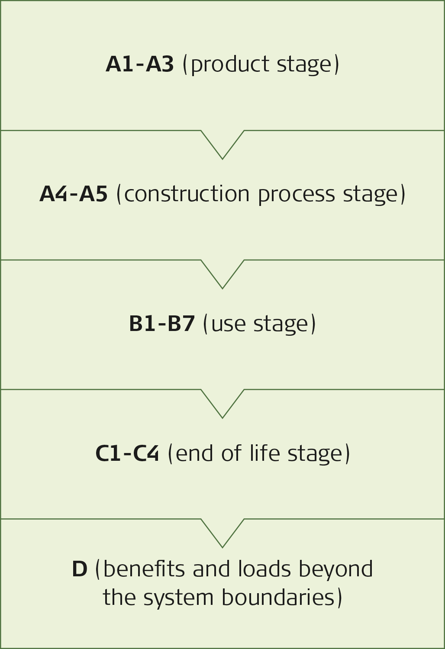
It's important to compare the same phases in a product's life cycle when looking at data. Please note that EPDs that have been drawn up in accordance with the old standard (EN 15804+A1) may include fewer phases than more recent EPDs (EN 15804+A2). This can make it difficult to compare data. EPDs based on EN 15804:2013 are also not directly comparable to EPDs based on EN 15804:2012+A2:2019 due to updated calculation methods.
Which units of measurement are you comparing?
The ‘declared unit’ in EPDs may vary. At Troldtekt, we use square metres as the unit, making it easy to calculate the footprint based on the overall ceiling area. In other EPDs, data may be calculated by things like product weight.
Is the EPD product-specific or generic?
Product-specific EPDs like those we use at Troldtekt describe how a specific building material affects the environment. However, if there is no EPD available for the exact building material you intend to use, you can either choose a so-called industry EPD based on averages for a type of building material or use generic data from a database.
If possible, you should always choose product-specific EPDs, as they provide the most accurate data.