How to use Troldtekt's EPDs in your building project
Environmental Product Declarations (EPDs) are an important tool for consultants and developers who need to document the environmental impact of the materials used in a building project. Here you can read about how to use Troldtekt's EPDs and what you need to be particularly aware of when looking at the figures.

EPD stands for Environmental Product Declaration and is the tool for professionals in the construction industry who need to know the environmental impact of different building materials.
Troldtekt has drawn up product-specific EPDs and these have been third-party verified in accordance with the European standard EN 15804+A2.
The current versions were published in 2025 and will remain valid until 2030. During this period, we expect to issue updated EPDs as we succeed in reducing our environmental footprint.
Why are EPDs important?
An EPD enables architects, contractors or developers to assess the environmental impact of various building materials, including Global Warming Potential (GWP), which shows the carbon footprint of the material. Based on the various examples of data available in the EPDs, you can compare the pros and cons of different building materials in an informed manner.
In some countries, such as Denmark, the authorities have set an upper limit for the permitted carbon footprint in new buildings. In Denmark, the limit is set as a carbon footprint per square metre per year. In other countries, such as Sweden, the total carbon footprint of the building is calculated over 50 years. When documenting your carbon footprint, product-specific EPDs play a key role. In Troldtekt’s EPDs, the carbon footprint is calculated as a total value measured over a service life of 50 years.
What you need to pay particular attention to when comparing EPDs
There are several things to be aware of when comparing EPDs for products. Here are four of the most important:
> What standard has the EPD been drawn up according to? In 2021, it became a requirement for EPDs to be developed in accordance with the EN 15804+A2 standard. Nevertheless, it is worth noting that EPDs are generally valid for five years, so you will still encounter EPDs that have been drawn up in accordance with the previous standard, EN 15804+A1.
> Does the EPD match the product you are looking at? Manufacturers may publish different EPDs for different products, just as new product updates may not yet be included in the EPD.
> Are you comparing the right phases? It's important to compare the same phases in a product's life cycle when looking at data. Please note that EPDs that have been drawn up in accordance with the old standard (EN 15804+A1) may include fewer phases than more recent EPDs (EN 15804+A2). This can make it difficult to compare data.
> Which units of measurement are you comparing? The ‘declared unit’ in EPDs may vary. At Troldtekt, we use square metres as the unit, making it easy to calculate the footprint based on the overall ceiling area. In other EPDs, data may be calculated by things like product weight.
> Is the EPD product-specific or generic? Product-specific EPDs, such as Troldtekt’s, describe how a specific building material affects the environment. However, if there is no EPD available for the exact building material you intend to use, you can either choose a so-called industry EPD based on averages for a type of building material or use generic data from a database. If possible, you should always choose product-specific EPDs, as they provide the most accurate data.
Who prepared Troldtekt’s EPDs?
The manufacturer of the building material prepares the EPD. The declaration is based on a comprehensive life cycle analysis, which, in the case of Troldtekt, has been prepared by the external LCA Consultant. Stefan E. Danielsson.
Troldtekt’s EPDs were published by the Danish organisation EPD Denmark and were third-party verified by one of the independent verifiers affiliated with EPD Denmark. This means that we use two different external parties to prepare and verify our EPDs.
How do you use the EPDs in practice?
As a consultant or installer, you can enter a given amount of Troldtekt acoustic panels into an overall digital life cycle calculation of the environmental footprint of a building project. The digital format saves time compared to manual entry and also minimises the risk of errors.
What data do Troldtekt’s EPDs show?
In our EPDs, you can see the environmental footprint for the entire life cycle of the acoustic panels. This includes the following phases:
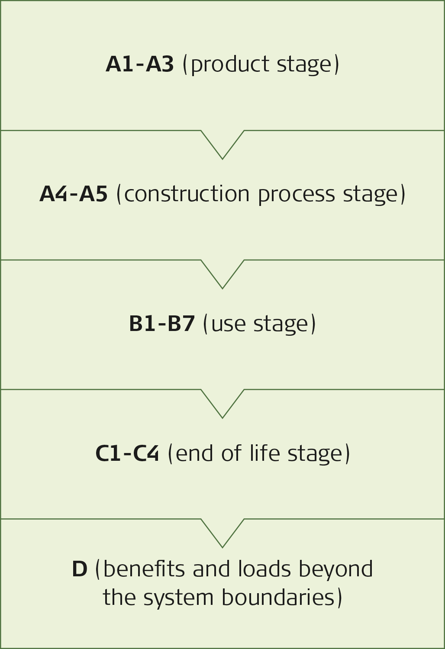
Not all phases are mandatory to declare in all markets. As we sell Troldtekt products in a number of markets and want to ensure complete transparency regarding our products’ footprint, we have chosen to include and show all phases.
Which Troldtekt products are included in the EPDs?
We have had EPDs drawn up for two basic panels. One of them is available in natural wood and is therefore based on white cement, while the other is based on the cement type FUTURECEM™.
> Troldtekt acoustic 25 mm (natural wood)
> Troldtekt acoustic 25 mm (FUTURECEM)
Note: The data in the EPDs applies to unpainted panels. If you choose a painted variety of the panels, you also need to enter a value for the paint, which can also be found in the EPD.
Note: Similarly, you will need to convert the data with a factor if you choose a Troldtekt panel with a thickness other than 25 mm (i.e. 35 mm). The conversion factor has also been included in the EPD.
How to read the tables in the EPD
The tables showing the results of the life cycle analysis are a key element of the EPDs. Here, the footprint of the materials in different life cycle phases is shown using different units depending on whether we are looking at carbon footprint, acidification, energy consumption or something else.
> Column 1 shows what the figures express. One example is GWP, which stands for Global Warming Potential. The abbreviations are explained under each table.
> Column 2 shows the unit of measurement used. For GWP, the unit is ‘kg CO2-Eq.’, which stands for carbon dioxide equivalent per square metre of building material. The figure includes all greenhouse gases and the different environmental footprints are converted to a comparable (equivalent) value.
> The other columns show the life cycle phases of the building material to which the value relates.
The numerical values in the tables are expressed using scientific notation. E+ means that zeros must be added after the number and E- means that zeros must be added before the number (decimal number). Finally, E+0 means that the number prefix is the real value. This is demonstrated here in three examples:
- -1.82E-01 corresponds to the value -0.182 (Natural wood, GWP total in A1-A3)
- 2.27E+01 corresponds to the value 22.7 (Natural wood, GWP total in D (scenario (ii))
- 1.10E+00 corresponds to the value 1.10 (Natural wood, GWP total in A5)
Why are some phases negative and some positive?
While EPDs are effective tools for obtaining an overview of a building material’s environmental impact during different phases of the life cycle, the phases must always be viewed in context. Among other things, in an EPD, the sum of biogenic CO2 must always be zero. This means that carbon stored in the product in one phase must be released again in a later phase (the method is called -1/+1).
Biogenic CO2 covers the carbon dioxide that forms part of the biological carbon cycle and is stored in biobased raw materials such as wood. Conversely, fossil CO2 comes from oil, coal and gas.
Let’s use Troldtekt as an example:
> I The raw materials used in Troldtekt’s acoustic panels are wood and cement. While cement production results in significant carbon emissions, the opposite is the case for wood, as carbon is stored in the wood when the tree is growing. This is what we refer to as biogenic CO2.
> The combination of wood and cement gives Troldtekt a relatively low carbon footprint during the raw material phase and, as we mainly use carbon-neutral energy types in production (wind power and biofuel from our own burner), the overall carbon footprint is below zero in the product phase, A1-A3.
> However, biogenic CO2 is released from the wood again at the end of the service life and phases C3/C4 therefore have a positive carbon footprint. Overall, the raw material wood is therefore carbon-neutral in the life cycle calculation.
Do the regulations differ from country to country?
There are significant differences between national regulations, and it is important that you familiarise yourself with the regulations in the market where you are building. In some countries, such as Denmark, an upper limit has been set for the carbon footprint of new buildings. The limits may be different or non-existent in other markets.
When calculating a building’s life cycle assessment (LCA) in accordance with national regulations, you must also be aware of which EPD phases may be included. Typically, phase D cannot be included in the LCA calculation.
You should also be aware that in some countries, it is standard practice to calculate the building's total carbon footprint per square metre measured over 50 years, while in other countries, the standard practice is to convert this to an annual carbon footprint per square metre. The footprint for Troldtekt panels is calculated over 50 years and must therefore be divided by 50 when converting to an annual footprint per square metre.
Finally, there are some markets where the biogenic CO2 is completely excluded from the LCA calculation. This applies, for example, to Sweden and Norway. Instead of using the method -1/+1 described in the point above, the 0/0 principle applies here. The total life cycle footprint of a Troldtekt panel remains the same overall, regardless of which of the two methods you use, but it is distributed differently across the individual phases.
What is the carbon footprint of Troldtekt acoustic panels?
The graphs show the carbon footprint of Troldtekt acoustic panels in different lifecycle phases. Both of our basic panels (Troldtekt based on white cement and Troldtekt based on FUTURECEM) are shown in both an unpainted and a painted version.
> In phases A1-A3 (production), the footprint is negative for several of the variants, as the wood absorbs more carbon than is released during cement production, raw material transport and the manufacture of the acoustic panels.
> Phases A4-A5 (construction) include transport from Troldtekt’s factory to the building site (average) and cement-bonded wood wool waste from the building site, which is returned to Troldtekt. The carbon footprint is therefore positive.
> During phases B1-B7 (use), the footprint is negative as Troldtekt acoustic panels store carbon through the chemical carbonisation process during use.
> During phases C1-C4 (end-of-life), the carbonfootprint is positive, as the biogenic CO2 is released from the wood.
> The recycling potential (in phase D) results in a negative carbon emission for Troldtekt, as the energy from incineration reduces the need for energy from fossil fuel.
Note: The overall carbon footprint will be slightly higher if landfill is used as the end-of-life scenario and slightly lower if the panels are crushed and enter the biological cycle at end-of-life. Both figures can be found in the EPDs.
Scroll to the right to see graph for painted Troldtekt panels.

